
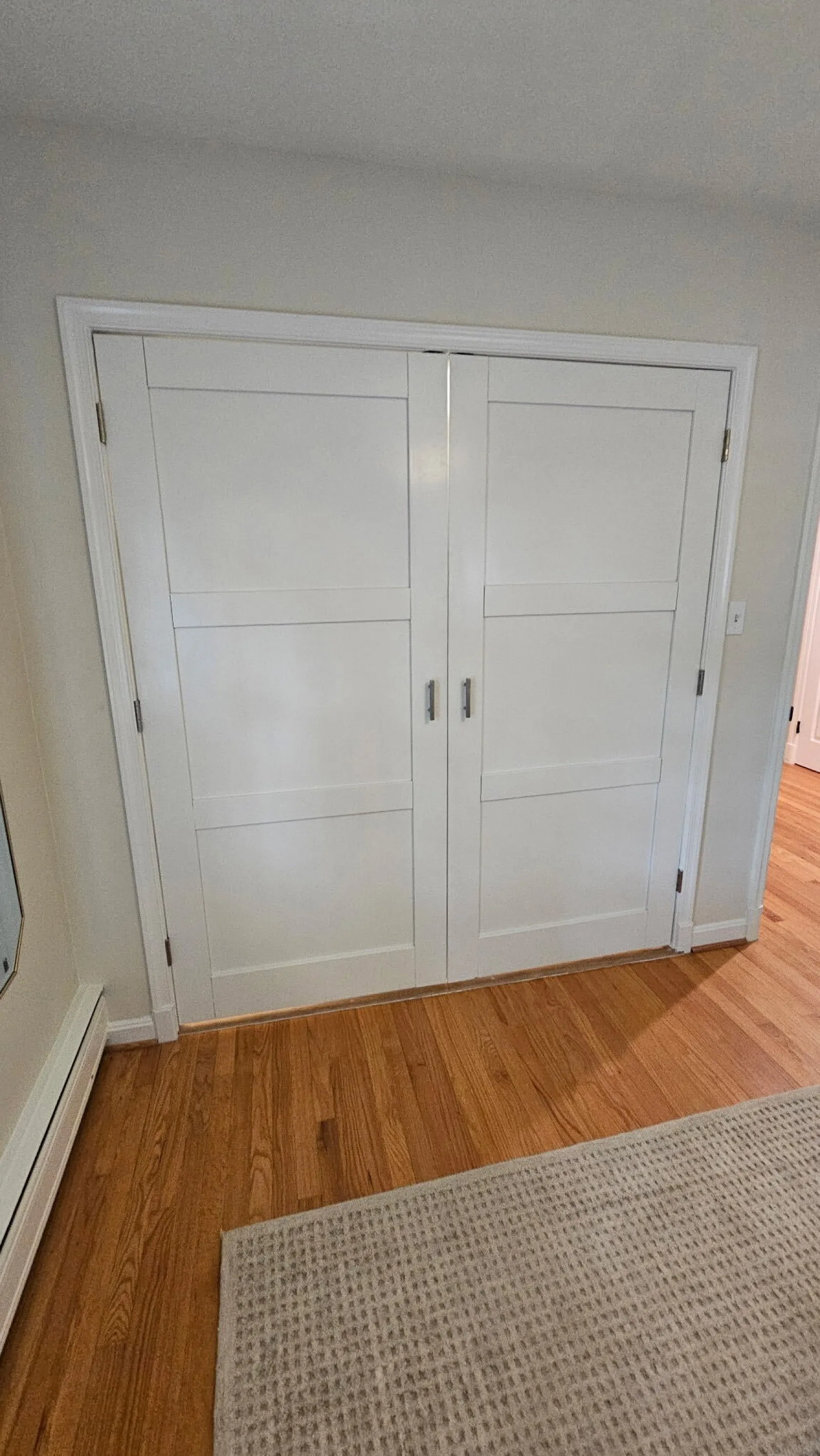
How much does it cost to replace interior doors?
Replacing an interior door costs $362 to $1,235 per door installed, with a published national average of $799. A basic hollow core slab in a sound frame lands near the bottom of that range, and a solid wood prehung door with new casing and paint lands near the top. Pocket doors, French doors and out-of-square openings in older Maryland homes push the number higher.
Those are market figures from published cost guides, not our quote. For what your doors need, our door installation and repair service page covers the work, and estimates are free. For front entry, storm and patio doors, see our exterior door replacement cost guide.
What does an interior door cost by type?
Most of the price difference is the door itself. Labor for a straight swap stays in a narrow band. Here is what HomeGuide and HomeAdvisor publish.
| Door type | Published cost installed |
|---|---|
| Hollow core swing door | $150 to $600 |
| Solid core swing door | $300 to $800 |
| Solid wood door | $500 to $1,235 |
| Bifold closet door | $100 to $300 |
| Double closet doors | $750 to $5,000 |
| Pocket door in an existing wall | $1,550 to $4,200 |
| French doors | $600 to $6,000 |
| Barn door | $200 to $2,500 |
The door-only prices explain the spread. Hollow core runs $30 to $400, solid core $70 to $500 and solid wood $160 to $590. Labor is $100 to $300 per door either way, so upgrading a bedroom door from hollow to solid core adds $40 to $100 to the job and cuts the sound coming through it.
Pocket doors are the outlier. Fitting one into an existing wall means opening the wall, framing the pocket and closing it back up, which is why HomeAdvisor lists the retrofit at $1,550 to $4,200 while a pocket door in new construction starts near $550.
Slab or prehung: which one saves money?
Prehung, in most cases. A slab is just the door, and it has to be fitted to the existing jamb by hand. Hinges get mortised, the strike gets set and the edges get planed until the door swings clean. Bob Vila puts that at three to six hours. A prehung door comes hung in its own frame, and a pro sets it in less than an hour to about two hours. The unit costs more, but the labor is one to two hours less.
| Approach | Door or unit | Labor | Best for |
|---|---|---|---|
| Slab | $30 to $590 | 3 to 6 hours | a square frame in good shape |
| Prehung | $60 to $1,000 | 1 to 2 hours | damaged jambs, out-of-square openings, whole-house swaps |
The frame decides it. HomeAdvisor’s guide says to replace the frame when the wood is rotted, split or warped enough to affect how the door works. A frame replacement runs $200 to $550 on its own. A prehung unit includes the frame, so when the old jamb is bad, prehung costs less than a slab plus a new frame.
Add-ons round out the number. Casing runs $0.50 to $1.50 per linear foot, or roughly $20 to $100 per door. Hinges are $8 to $50 per door, interior knobs $20 to $40, and painting both sides of a new door runs $163 to $332 in Homewyse’s calculator. Our interior painting crew handles the door and casing paint in the same visit.
When is a repair the better answer?
When the door sticks, rubs or will not latch. HomeAdvisor’s repair average is $239, with most fixes between $132 and $372. Planing a sticking door runs about $110 and a jamb repair about $240 in Angi’s figures. A hollow door with a fist-sized hole can often be patched for $75 to $250. Replacement starts at $500 and runs to $2,000 for the same opening.
Replace when the door is warped beyond a slight bow, water damaged, cracked through or hollow with real damage. Replace the frame when the jamb is rotted or split. A new slab hung in a bad jamb still will not close right, which is the most common reason a fresh door disappoints.
Why do older Maryland homes cost more per door?
Two reasons: the openings and the paint. The Census Bureau’s 2024 estimates put the median year built in Anne Arundel County at 1983, with about 45% of housing units built before 1980. Houses from the 1950s through the 1970s have settled, so openings drift out of square and doors that once fit now rub at the top corner. A prehung unit solves that with a new plumb frame, but the casing has to be scribed to walls that are no longer flat, which adds time.
The paint rule is the one owners miss. Any home built before 1978 falls under the EPA lead Renovation, Repair and Painting rule. Maryland’s Home Improvement Commission lists “modification or repair of painted surfaces such as doors” as covered work, with a threshold of six square feet of interior painted surface per room. Pulling a painted door, its jamb and its casing crosses that line, so the contractor has to be EPA certified, hand you the Renovate Right pamphlet before work starts and use lead-safe practices. Maryland is not on the EPA’s list of states that run their own program, so the EPA administers the rule here. The rule does not apply to owners doing the work themselves in a home they live in, but it applies to every paid crew.
Licensing follows the same logic. Maryland has no small-job dollar exemption for home improvement work, so a door and trim job with paint needs a licensed contractor. Licensed work is covered by the MHIC Guaranty Fund up to $30,000 per claimant, and the contract has to carry the license number. Old bracket holes and busted drywall around a rough opening go to our drywall repair crew in the same trip.
What should you do next?
Count the doors and check the frames. One sticking door is a repair call. Six mismatched doors on a 1970s upper floor are a prehung swap, and doing them in one visit shares the setup, the haul-away and the paint day. Angi’s Baltimore page puts handyperson labor at $54 to $72 an hour, and a prehung swap takes about two hours per door, so the math favors batching.
Our handyman vs contractor guide explains where the license line falls for door work. Call (877) 349-4632 with a photo of the door and the frame and the office can usually give you a price range the same day. Whole-floor swaps get a free written estimate at the house, and you know the number before anyone pulls a hinge pin.